
Choosing a Motorcycle Rain Poncho: A Buyer’s Guide for Wet-Season Markets
By RIDEVEL Editorial Team · · 8 min read
A motorcycle rain poncho earns its place on three checks: coverage that matches who rides, a waterproof figure a lab has actually measured, and heat-pressed seams that stay dry under pressure. This guide shows how to read each spec for worn rain gear, and how to verify the number a seller quotes before you place a wholesale order.
What a waterproof rating measures on gear you wear at speed
A waterproof rating is the water pressure a fabric blocks before it leaks. A lab pushes a rising column of water against the fabric and records the pressure at the first drop through. Most rider guides quote that pressure in millimetres of water column. Around 5,000 mm suits steady rain. Heavy, wind-driven rain needs 10,000 mm or more, and a few guides ask for 15,000 mm at highway speed, because wind adds pressure the still-water test never sees. The international method behind these figures is ISO 811, the hydrostatic pressure test for textiles. One kilopascal, written kPa, equals about 102 mm of water column, so a 20 kPa fabric holds roughly 2,000 mm. Read the bare word waterproof as marketing until a seller names both a method and a number.
The tested number behind our ponchos
Our poncho fabric holds 277.3 kPa of water pressure in accredited lab testing. That figure comes from report XSJC2205262254, issued under CMA accreditation 160808340306. On the water-column scale rider guides use, 277.3 kPa converts to more than 28,000 mm. That sits well past the 10,000 mm mark those guides call heavy-rain grade, and it clears the 20 kPa floor in China’s GB 29862 rain-fabric standard by more than 13 times. The same report marks 13 of 13 quality checks as pass, including a 241 N warp tensile load and grade 4 surface colour fastness. The lab followed ISO 811 and ASTM D751, the test methods for coated fabrics such as tarps and rain wear. You can read the full report on our quality page.
Match the coverage to how the family rides
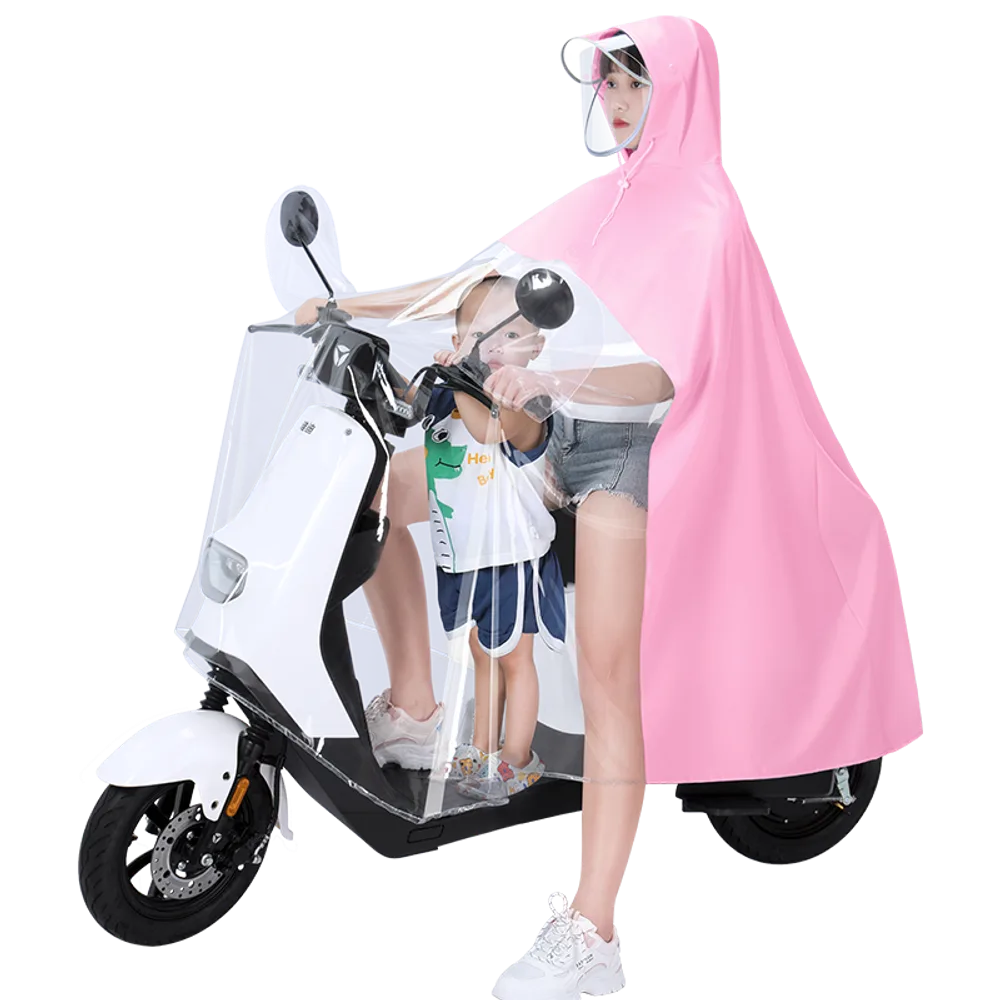
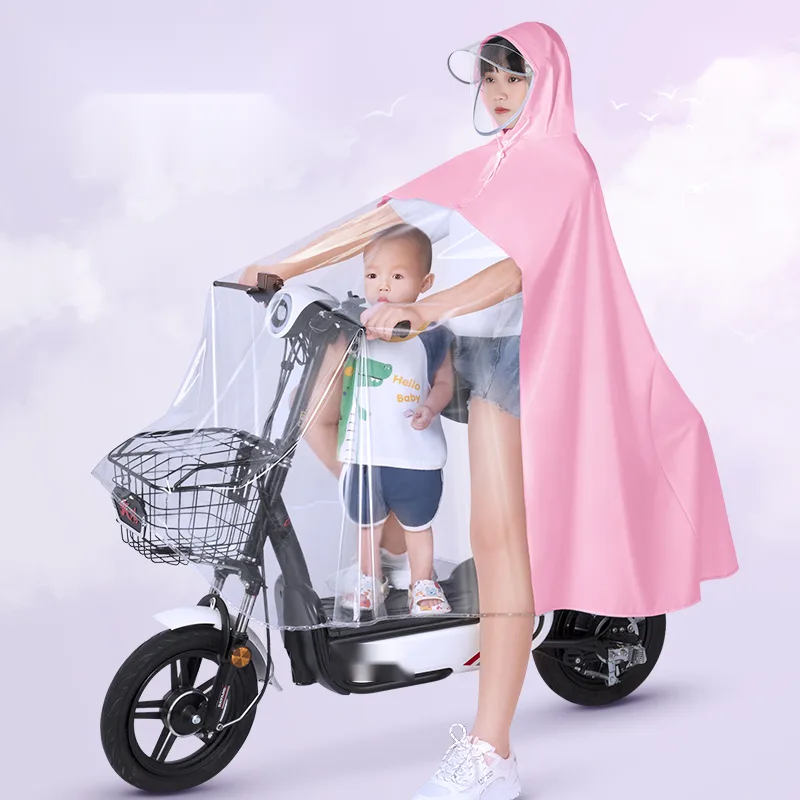
Coverage is the first choice, and it depends on who sits on the bike. A single rider stays dry under the one-person poncho, cut for one adult with a hood and a clear visor. A parent carrying a child in front needs the family version, sized for two to three people. Its front panel reaches forward over the handlebars into a wide shield with a clear window, so the child stays inside the dry zone while the rider still reads the dash. Both versions use the same 277.3 kPa PVC fabric, so coverage never trades away waterproofing. Compare the family rain poncho against the single-rider poncho before you decide which to stock in depth. In monsoon markets the family shield sells fastest to parents on the school run.
Seams are where a poncho leaks first
Seams fail before fabric does, because stitching punches needle holes along every join. We heat-press our poncho seams instead of stitching them, so the joins stay hole-free and water cannot track through. Seam strength deserves a lab number rather than a promise. On our EVA kids line, a whole-garment test measured water resistance at the seams as well as across the fabric, and both held above 180 kPa against a 120 kPa requirement, with 8 of 8 items passing (report 2611670453). That is a finished-garment result, not a fabric swatch. Ask any supplier whether the seams are welded or stitched, and whether a report tested the seam itself. Our waterproof tech page shows how the heat-pressed joins and the coating work together. A welded seam stays dry in the hose test below.
Fit, flex, and staying put at speed
A poncho has to move with the rider without splitting or ballooning. Our PVC fabric stretches 19.7% before it tears, so it flexes over the shoulders, mirrors, and handlebars without cracking at the fold lines. A lotus-effect surface beads water off instead of soaking it up, which keeps the poncho light and quick to dry between showers. Detachable twin brims sit above the visor and hold rain off the face without narrowing the view. At speed a loose hem is the enemy: it flaps, and wind drives water underneath even a high-rated fabric. Check that the hem grips with an elastic cord or a snap, and that the hood cinches down over a helmet. The tested 19.7% stretch and the welded joins do little if the poncho lifts in the wind, so the ageing and abrasion results on our quality page matter here too.
Colours, mirror sleeves, and private label
Five colours run in production: khaki, orange, purple, pink, and blue. Mirror sleeves are optional, and the choice tracks the local bike. Distributors in markets with wide-mirror scooters usually take the sleeved version, while narrower-bike markets take the sleeveless one. Print, colourway, hem, and packaging can all change for a private-label programme, because the pattern prints onto the film before the garment is welded, not stuck on afterward. That order matters for waterproofing: a printed-then-welded film keeps its 277.3 kPa rating, while a sticker or a late coating can lift at the edges. See the current range and finishes on the family poncho page, then tell us which colours move in your market. We can match a house colour for a large run rather than force a stock palette onto your shelves.
Sourcing a wet-season order
A sourcing decision needs real terms, not a slogan. RIDEVEL is an export supplier based in Huai’an, Jiangsu, so we ship from partner mills under our own quality checks rather than from a factory we own. We quote the minimum order and the lead time against your exact specification, colour split, and sleeve option, instead of posting a figure we have not verified. Waterproofing stays fixed across the range at 277.3 kPa (report XSJC2205262254), so a mixed order of single and family ponchos carries the same tested fabric. Send your destination market and monthly volume through our request form, and we return the real MOQ, price, and sample terms. For logo, packaging, and colour work, see our OEM and private-label options. The rating maths sits in our e-bike cover guide if you want the mm and kPa detail. Buyers adding a children’s line can also read our kids raincoat buyer’s guide.
A ten-minute test before you commit
You can test a poncho in your own weather in ten minutes. Put it on the bike or a frame, then spray the seams and the top panel with a hose. Water should bead and run off, not soak in. Open the poncho and feel the inside of each seam for damp. A heat-pressed seam stays dry, while a stitched one shows wet needle lines. Our fabric holds 277.3 kPa in the lab, and this hose test tells you whether the unit in your hand left the line built to that spec. Leave it on through a heavy shower and check for pooling at the shoulders. If a sample leaks at the seams on the first day, reject the batch and ask for the seam report the way our quality page lists report XSJC2205262254.
Care that keeps a poncho near its tested rating
A poncho holds near its tested numbers for years if riders treat it right. Rinse road grit off with plain water after a heavy week, and skip harsh solvents that strip the coating and pull the surface below its 277.3 kPa starting point. Hang it to dry before folding, because a poncho packed away wet grows mildew along the seams. Fold it loosely instead of cramming it into a pocket, so the heat-pressed joins keep their shape and the film never creases into weak lines. The PVC passed abrasion and ageing checks in the same report, which is why it takes daily folding without cracking at its 19.7% stretch. Retailers who print these steps on the hang tag see fewer returns, because most early failures trace to storage rather than the fabric. A poncho that lives in its own pouch on the bike gets used, and a used poncho gets reordered.
Built for Southeast Asia’s daily downpour
Riders in Vietnam, Indonesia, and the wider region face months of daily rain, not the odd shower. A poncho here gets soaked, dried in strong sun, folded, and worn again the next morning, hundreds of times in a season. Our PVC passed abrasion, flex, and ageing checks inside the same 277.3 kPa report, which points to a longer life under that cycle. The clear front window and detachable brims keep sight lines open in grey monsoon light, when a rider most needs to see the road. A poncho that holds 277.3 kPa but cracks after a month of sun is a false economy, so the ageing result matters as much as the headline pressure. For shops selling into wet-season peaks, that durability is what turns one sale into a repeat order. Our quality page lists the ageing and abrasion figures in full.
Common questions from buyers
What waterproof proof should I ask for? Ask for the test report number and the standard, the way our quality page lists report XSJC2205262254 under GB 29862. How high is the rating? The poncho fabric holds 277.3 kPa, more than 13 times the 20 kPa floor for rain fabric. Is the seam tested too? On the EVA kids line a whole-garment report held the seams above 180 kPa, and the poncho seams are heat-pressed with no needle holes. Can I sell these in the United States? The kids line is not US-ready, and we will not pretend it is, so tell us the market and we quote the extra testing first. What is the minimum order? We quote it against your specification rather than post a figure we have not checked.
More from this line
Need covers for your shop or fleet?
Tell us your bike sizes and monthly volume, and we will send sample terms and a quote.
Request a quote