
How to Choose a Kids’ Raincoat: A Buyer’s Guide
By RIDEVEL Editorial Team · · 7 min read
A kids' raincoat comes down to three things: a lab-tested waterproof rating on the finished garment, a hood with no neck drawstring, and a size that fits with room to grow. Our EVA kids raincoat held above 180 kPa on both fabric and seams in accredited testing, report 2611670453.
What "waterproof" really means for a kids' raincoat
A waterproof rating tells you how much water pressure a fabric blocks before it leaks, and it is the first thing to check on a kids' raincoat. A lab raises a column of water against the fabric and records the pressure at the first drop through. Rain-gear guides usually quote that pressure in millimetres of water column, where 1,500 mm suits light drizzle and 5,000 mm handles steady rain. The international method behind the figure is ISO 811, the hydrostatic pressure test for textiles. One kilopascal, written kPa, equals about 102 mm of water column, so a coat rated 120 kPa holds roughly 12,000 mm. Many children’s raincoats sold online carry the word waterproof and no number at all. When a seller cannot name a method or a figure, read waterproof as a marketing word and ask for the test.
Why a whole-garment test beats a fabric swatch
The weakest point of a raincoat is the seam rather than the panel, because a stitched seam punches a needle hole at every stitch and water tracks through those holes. Most suppliers test a flat fabric swatch, which never shows how the seams hold. Our kids raincoat was tested as a finished garment, model 919, so the lab measured the seams as well as the cloth. Report 2611670453 records seam seepage above 180 kPa against a 120 kPa requirement, level with the fabric itself. The seam bond held at 36 N against a 30 N minimum in the same report. We weld the seams with heat instead of stitching them, so the joins carry no needle holes. Ask any supplier one question before you buy: did the lab test the fabric swatch or the finished coat? You can read the full report on our quality page.
The number to ask a supplier for
A single figure separates a tested raincoat from a hopeful one: the hydrostatic pressure the fabric held, with the report behind it. Our EVA raincoat held above 180 kPa on both fabric and seams, more than the 120 kPa the standard asks for, and passed 8 of 8 measured items in report 2611670453. That report was issued under CMA accreditation 221100110161 and CNAS recognition L0116, two codes you can check. On the water-column scale the guides use, 180 kPa converts to more than 18,000 mm. Ask a supplier for three things: the kPa or mm figure, the report number, and the accreditation code. A seller who ships tested goods produces all three in a minute. A seller who cannot usually has a swatch photo and a slogan. See the tested numbers for the line on our kids raincoats page.
Hood and neck safety comes before style
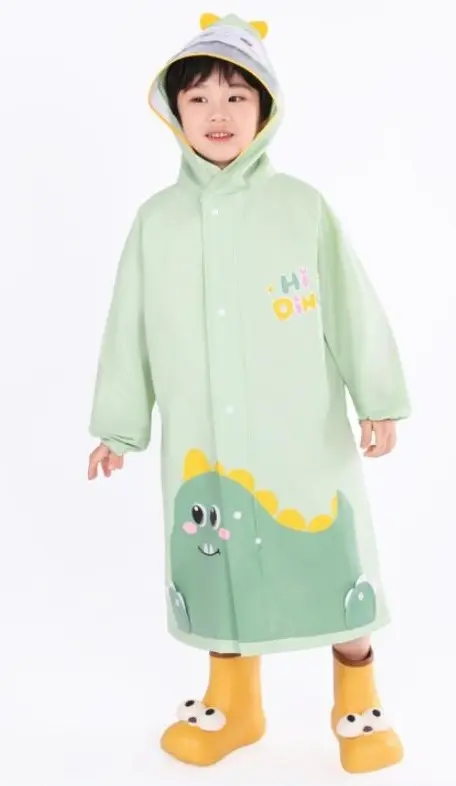
A hood keeps rain off a child’s face, and its safety matters more than its shape. Neck and hood drawstrings on children’s outerwear have caught on playground equipment and bus doors, so the United States restricts them under ASTM F1816, the safety specification for drawstrings on children’s upper outerwear. That rule exists to prevent strangulation and dragging injuries. Our 919 raincoat uses a moulded 3D animal hood and a detachable clear face visor, with no drawcord at the neck or hood. The clear visor keeps rain out of a child’s eyes while they still see the path ahead. The hood comes in six animal designs, so a child picks the one they will actually wear. Choose a hood that seals against rain and carries no cord near the neck, then let the design follow. The tested EVA raincoat shows the hood construction in detail.
Fit a raincoat to a growing child
Size is where a good raincoat is won or lost, because a coat that runs too tight rides up and lets rain in at the wrists. Our 919 raincoat comes in four sizes: S fits 80 to 95 cm, M fits 95 to 110 cm, L fits 110 to 125 cm, and XL fits 125 to 140 cm. Cloth length runs 58, 67, 75, and 83 cm across those four sizes, and chest width runs 42, 44, 46, and 48 cm. A one-piece cut with long cuffed sleeves keeps water off the arms while a child holds a scooter or a school bag. Buy one size up if a child sits between two heights, so the coat lasts a second wet season. The sleeves and hem should clear the hands and hips without dragging on the ground. Match the child’s height to the size chart on the 919 raincoat page before you order a full run.
EVA, PVC, or a thin unnamed film
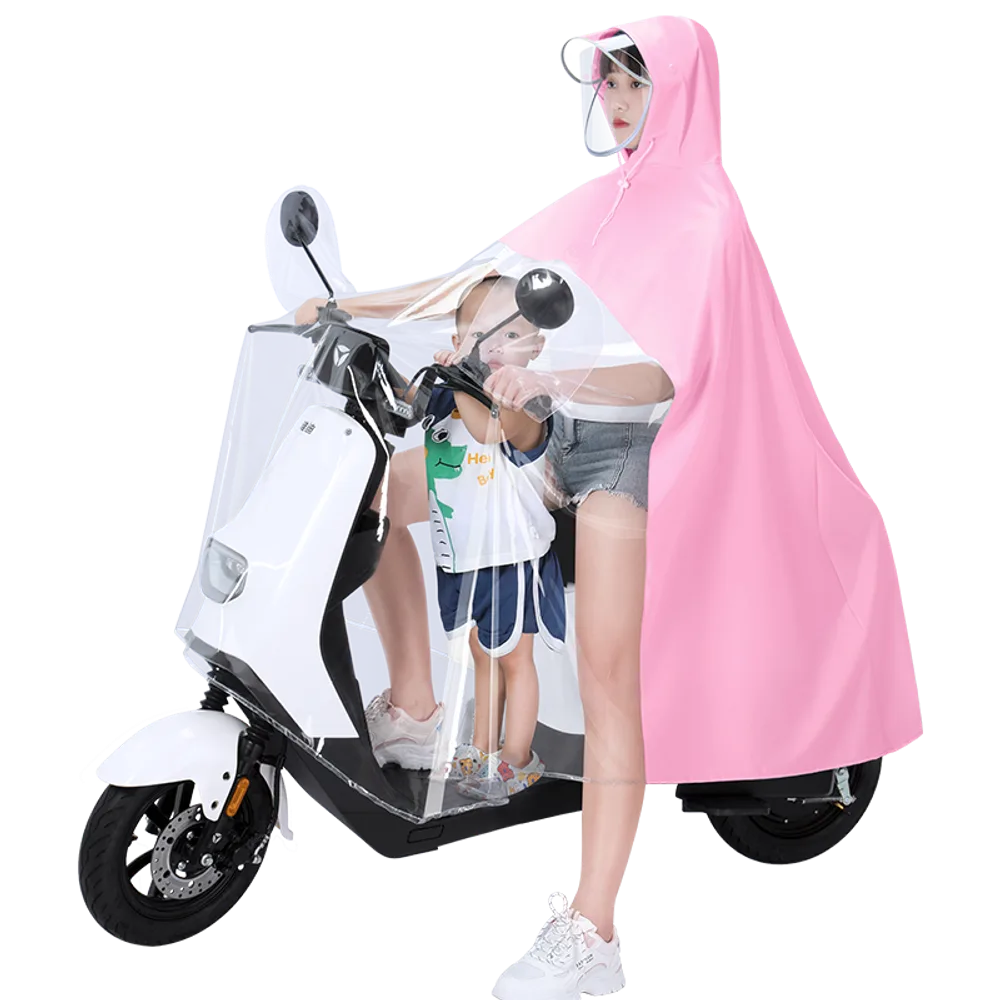
Material decides how a raincoat feels on a child and how long it lasts. We use EVA for kids raincoats because it stays soft and light against the skin and does not stiffen in cold air the way heavier films do. The EVA in our 919 stretched 736 percent along its length and 614 percent across its width before it broke in report 2611670453, well above the 200 percent the standard asks. Breaking strength reached 104 N along the length and 129 N across the width, against a 30 N minimum. We reserve PVC for adult e-bike covers, where our cover fabric held 277.3 kPa in a separate report, XSJC2205262254. A thin unnamed film with no coating name and no test is the one to avoid, since it cracks within a season. Our e-bike cover guide explains the PVC side in full.
Will the colour run onto a child’s skin?
Dye that bleeds in the rain is a fair worry for a coat worn against a child’s clothes and skin. The 919 raincoat passed the colour-fastness check in report 2611670453 with no bleed, meeting the no-colour-loss requirement the standard sets. A coat that runs can leave a stain on a school shirt or a pale jacket underneath, and cheap prints often do exactly that in the first heavy shower. Bright animal prints on our hoods use the same tested material as the body, so the colour on the hood holds to the same result. Ask a supplier whether the colour-fastness line appears in the test report, not only on the label. You can see the colour-fastness result alongside the other seven checks on our quality page. A print that stays put keeps a good coat looking new for a second child.
Buying for a market, not just for the rain
Compliance decides whether a tested raincoat can actually sell in your country. A Chinese CMA and CNAS report proves the garment’s water resistance and strength, and report 2611670453 does that for the 919. That report does not, on its own, make the coat ready for the United States, where children’s outerwear needs a CPSIA Children’s Product Certificate based on CPSC-accepted lab testing, plus a hood and neck that meet the drawstring rule. We will not pretend a Chinese report covers a US certificate, because the two test to different rules. Tell us the destination market and we will quote the extra testing before you place an order. Buyers who want custom colours, packaging, or a private label can start on our OEM and wholesale page. Honest paperwork up front saves a shipment held at customs later.
A ten-minute check before a bulk order
You can check a raincoat sample in ten minutes before you commit to a full order. Turn the hood and shoulders under a running tap and watch where the water goes. Water should bead and run off the surface, not soak into the cloth. Open the coat and feel the inside of each seam for damp lines, since a welded seam stays dry while a stitched one shows wet needle marks. Pull the sleeves and hood gently to feel the seam bond, which the 919 held at 36 N against a 30 N minimum. Leave the sample on a hanger overnight and look for any drip line by morning. Our EVA fabric held above 180 kPa in the lab, and this bench test tells you whether a given sample left the line built to that level, the way report 2611670453 records on our quality page. If a sample leaks at the seams on day one, reject the batch.
Common questions from buyers
Was the fabric or the finished raincoat tested? The finished raincoat. Report 2611670453 lists the sample as a children’s raincoat, model 919, and measured water resistance at the seams as well as the fabric, both above 180 kPa against a 120 kPa requirement. Which sizes are available? Four, from S at 80 to 95 cm up to XL at 125 to 140 cm. Is this ready to sell in the United States? Not yet, and we will not pretend otherwise, because the US market needs a CPSIA certificate and a drawstring check the Chinese report does not cover. What proof of waterproofing should I ask for? Ask for the kPa figure, the report number, and the accreditation code, the way our quality page lists report 2611670453 in full. Send us the child heights and monthly quantities through our contact form for a sample and a quote.
More from this line
Need covers for your shop or fleet?
Tell us your bike sizes and monthly volume, and we will send sample terms and a quote.
Request a quote